An Honest Review of Timeleft (2026)
By Søren · Published 2026
I signed up for my first Timeleft dinner on a Wednesday. I almost didn't go. I sat in my apartment for twenty minutes, shoes on, telling myself it would be weird, that I'd have nothing to say, that the whole thing was a gimmick. Then I went anyway. And I had one of the best nights I'd had in months.
Here's what one Timeleft dinner actually looks like.

How It Works
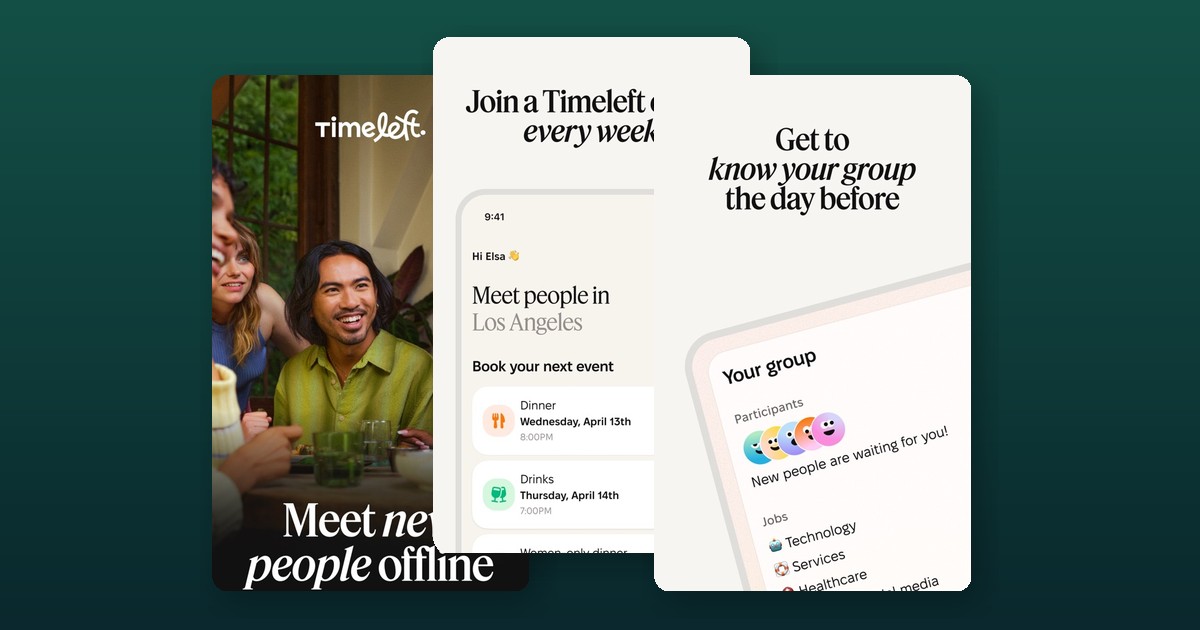
If you haven't used Timeleft before, here's the setup. You download the app, take a personality test (it takes about ten minutes), pick your city, and book a Wednesday. The app's algorithm uses your personality test results to build a table of six people who should get along. On Wednesday afternoon, you get a push notification with the restaurant name and your table number. You show up at 8 PM, find your table, and spend the next two to three hours eating dinner with five people you've never met.
That's it. No icebreaker games. No moderator. No agenda. Just dinner with strangers.
What I Liked
The Wednesday format is smart
Wednesday night is a clever choice. It's the middle of the week, when most people don't have plans. It gives you something to look forward to in the slog between Monday and Friday. I can see how this could become a ritual, a standing social commitment you block off without thinking about it. The consistency of the format is one of its best features, even though it sounds like a limitation on paper.
The algorithm seemed to work
I was skeptical about the personality matching. How much can a ten-minute quiz really tell you? But my table had a specific quality to it: everyone was roughly on the same wavelength. Not identical people, but people who were curious, open, and willing to go past small talk. It felt like more than random chance, and I think the algorithm deserves some credit for that.
The no-choice design
You don't pick who you eat with. You don't pick the restaurant. You barely pick anything at all. And that's the point. I've used apps like Bumble BFF where the matching is up to you, and the paradox of choice kills it. You swipe, you overthink, you never commit. Timeleft removes all of that. You just show up. For people who tend to talk themselves out of social plans, this design is perfect.
Low barrier, high reward
Walking into a restaurant and sitting down at a table is about as easy as socializing gets. You don't have to introduce yourself to a room full of people. You don't have to work up the nerve to approach anyone. The table is right there, the people are already seated, and the food gives everyone something to do with their hands. The first five minutes were a little awkward, and then someone cracked a joke and we were off.

What I Didn't Like
The cost adds up
Timeleft charges about $13/month for the subscription. Then you pay for your own dinner. In New York, that means your Wednesday night runs $50-80 once you factor in food, drinks, tax, and tip. If you went every week, you'd be looking at $200-300 a month. That's a real budget line item. Every other week feels more sustainable.
Wednesday-only is limiting
I get why they picked one night. It creates the ritual, it simplifies operations, it makes the brand memorable. But if Wednesday doesn't work for you on a given week, that's it. You can't reschedule to Thursday. You can't do a weekend brunch instead. I'd love to see them add a second night, even if it was just in bigger cities.
Not every table will click
I got lucky. My table was great. But the marketing makes every dinner look like a scene from a movie, and I'm realistic enough to know that not every group of six random humans is going to click, no matter what the algorithm says. Sometimes conversation stays surface-level. Sometimes the energy just isn't there. That's the gamble with any stranger-matching format.
No built-in follow-up
After dinner, Timeleft creates a group chat for your table. In theory, this is where you stay connected. In practice, someone sent "great meeting everyone!" that night, a couple people responded, and I can already tell the chat will go silent. I exchanged Instagrams with two people I really liked and hope to see them again. But the app itself doesn't do much to help you turn a good dinner into an actual friendship. It's an introduction service, not a relationship builder.
City quality varies
I did Timeleft in New York, which is their strongest market, so the pool of people was deep and the restaurant was good. I've heard from friends in smaller cities that the experience is spottier. Fewer people in the matching pool means less precise matching. Fewer restaurant partnerships means you might end up at a mediocre spot. If you're in a city with a big Timeleft presence, the experience should be great. If not, your mileage may vary.

The Night I'll Remember
The restaurant was a small Italian place in the West Village. The six of us were all between 26 and 33, all transplants to New York, all in that specific phase of adult life where you have a job and an apartment but not really a community yet. We talked for three hours. We closed the restaurant. Four of us went to a bar afterwards and stayed until midnight.
Nobody was performing or trying to impress anyone. It was just honest, interesting people being themselves over pasta. That kind of night is what Timeleft is selling, and on my first try, it delivered.
Who Should Try Timeleft
If you've moved to a new city and don't know many people, Timeleft is the single best place to start. It's also great if you have an established social circle but want to meet people outside your usual bubble. If you're an introvert, the small group format (six people, one table) is far less intimidating than a networking event or a big Meetup group.
It's less ideal if you're on a tight budget, if Wednesdays are consistently bad for you, or if you're looking for deep friendships right away. Timeleft gives you introductions. What you do with them is up to you.
The Verdict
Timeleft might be the best app in the IRL social space right now. The concept is simple, the execution is clean, and my first experience was genuinely great. The Wednesday night dinner with strangers format just works.
It's not perfect. It's expensive if you go every week. The algorithm won't always nail it. Wednesday-only is rigid. And the app does a better job getting you to dinner than helping you build lasting connections from it.
But here's what matters: I'm already booking my next one. That says more than any review can.