Base vs Better Off
Base and Better Off are both friendship apps that help you meet people in real life, but they take different approaches. Here’s how they stack up across pricing, format, cities, and more.
Side-by-side comparison · Updated 2026
At a glance
Pricing
Base is priced at $$$ ($100/month + event costs extra), while Better Off comes in at Free (Free to join; individual experiences vary in cost (some free, others paid)).
Format & matching
Base uses groups of 6-12 per event, compared to Better Off’s Varies, and both use algorithm-based matching.
How they work
Base: Head to base.club and fill out their application form. You'll select your city, choose a personality archetype (Artist, Scholar, Sage, Explorer, Leader, Healer, or Alchemist), and share what you're looking for — community, intellectual conversation, networking, or inspiration. Every applicant has a one-on-one call with the membership team before being accepted, so this isn't a sign-up-and-go situation. Once you're in, Base matches you to weekly events: intimate Circles with guided conversation prompts on the table, curated Experiences like tastings or workshops, and matched dinners at rotating venues across your city. The algorithm learns your preferences over time based on your attendance and feedback.
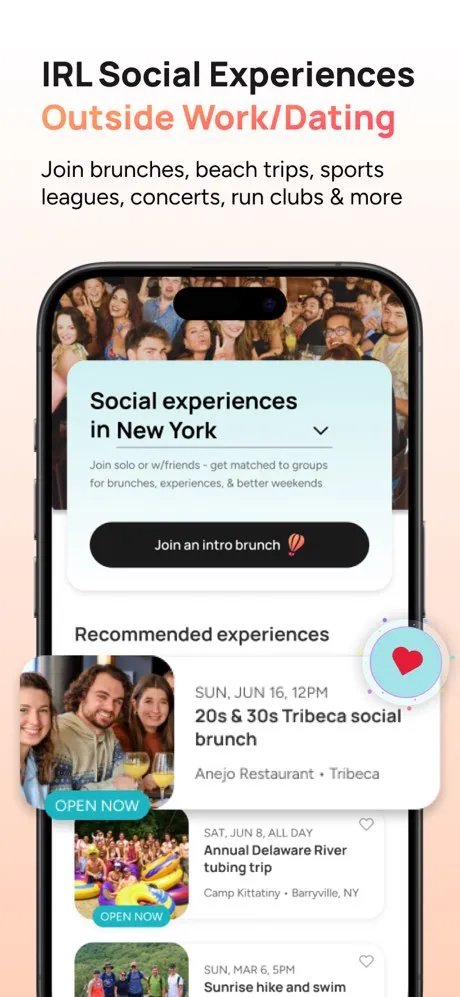
Better Off: Download the app and create a free account. Take a quick personality quiz that covers your interests, social style, and what kind of experiences you're into. Browse upcoming experiences in your city — brunches, run clubs, trivia nights, ski weekends, sushi-making classes, museum happy hours, you name it. Register for one, and Better Off's AI matching system assembles a group of people who fit your personality and preferences. You'll get the details before the event. Show up, hang out with your group, and stick around for the after-bar to meet everyone else.
What to love
Base: Personality-based matching creates genuinely interesting tables. Vetted membership keeps the quality of conversations high. Variety of event formats — dinners, circles, and experiences — keeps things fresh. Available in 10+ US cities with more launching in 2026. The archetype system adds a fun, intentional layer to the matching.
Better Off: AI-powered matching goes beyond basic interests — uses neural networks similar to TikTok's recommendation engine. Massive variety of experiences from casual brunches to multi-day ski trips. Works for solo joiners and existing friend groups alike. Available in 10+ US cities with both iOS and Android apps. Free to create an account and browse — you only pay for individual experiences.
Reality check
Base: $100/month is steep, especially since event costs are extra on top. Application and vetting process means you can't just sign up and go tonight. No iOS or Android app — everything runs through the website. Limited to US cities for now — no international availability.
Better Off: Experience costs vary widely and aren't always transparent upfront. Quality depends on what organizers are running in your city — some markets are thinner than others. The AI matching is a black box — you can't see exactly why you were grouped with certain people. No structured post-event community or follow-up features to maintain connections.
Søren's take
On Base: Base feels like what you'd get if Soho House and Timeleft had a baby — the exclusivity of a members' club with the personality-matching smarts of a modern social platform. The vetting process is a double-edged sword: it keeps out the LinkedIn pitch-bro energy, but it also means you can't impulse-join after a lonely Tuesday. At $100/month plus event costs, it's not cheap, but the people who thrive here are the ones who show up consistently and let the matching algorithm learn them. If you're in one of their cities and want curated, intellectually stimulating social experiences without the cringe of traditional networking, Base is worth the application.
On Better Off: Better Off sits in an interesting sweet spot between a social matching app and an event marketplace. The AI matching is the real differentiator — instead of just showing you a list of events and letting you figure it out, they're actually assembling groups of compatible people for each experience. The variety is impressive too: this isn't just another dinner-with-strangers app. The downside is that experience quality and availability depend heavily on your city. If you're in NYC or LA, you'll have plenty of options. Smaller markets might feel sparse. Worth trying if you're the kind of person who'd rather bond over an activity than sit across from a stranger at a bar.