GameTree vs Hampton
GameTree is a friendship app and Hampton is a networking app. They take different approaches to helping you meet people IRL — here’s a detailed comparison.
Side-by-side comparison · Updated 2026
At a glance
Pricing
GameTree is priced at Free (Free with optional premium features), while Hampton comes in at $$$$ (Annual membership (pricing disclosed during application process)).
Format & matching
GameTree uses groups of 1:1 and squads, compared to Hampton’s 8 per core group, and GameTree relies on algorithm-based matching while Hampton uses manual / self-select matching.
How they work
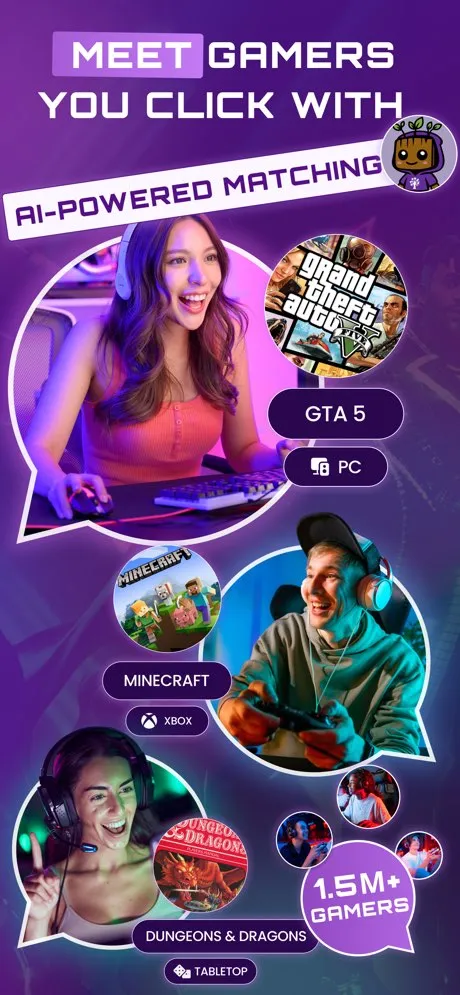
GameTree: Download the app and take a gamer personality quiz that maps your playstyle, favorite genres, and what you're looking for — competitive grinders, casual co-op partners, or just people to hang out with on Discord. Add your games and platforms (PC, Xbox, PlayStation, Switch, mobile — it covers everything). GameTree's AI matches you with compatible players based on personality psychology, not just shared game libraries. Browse your matches, send friend requests, and start chatting. There's also a Discord bot with /lfg commands for instant squad-finding in your server.
Hampton: Head to joinhampton.com and submit an application. Hampton is invitation-only with an ~8% acceptance rate — you'll need to be an active founder or CEO of a tech-enabled business with at least $3M in annual revenue, $3M in capital raised, or a $10M+ previous exit. If accepted after a paper screening, structured interview, and community veto process, you pay an annual membership fee and get placed into a Core group of eight curated founders in your city. Your Core group meets in person ten times a year, facilitated by a trained moderator. Beyond that, you get access to local chapter events (dinners, workshops, signature experiences) and a private Slack network of 1,000+ members for rapid Q&A on business and personal topics.
What to love
GameTree: AI personality matching goes deeper than just 'we both play Valorant' — it considers playstyle and social preferences. Truly cross-platform: PC, Xbox, PlayStation, Switch, and mobile all in one app. Discord bot integration lets you find teammates without leaving your server. Supports 1,300+ games from AAA shooters to tabletop RPGs. Over 1 million downloads on Android alone — large enough player pool to find matches.
Hampton: Extremely curated membership — ~8% acceptance rate ensures high-caliber peers. Core groups of 8 create real accountability and trust over time. In-person only meetings in your city — no Zoom calls pretending to be community. No-solicitation policy means nobody is trying to sell you anything. Bootstrapped company with long-term vision — not optimizing for a VC exit.
Reality check
GameTree: The app can feel cluttered and overwhelming on first use. Match quality varies — the AI doesn't always nail personality compatibility. 3.2-star rating on Google Play suggests inconsistent user experience. Free tier limitations push toward premium features.
Hampton: Pricing is not transparent — you have to apply just to learn the cost. Strict eligibility requirements exclude early-stage founders. Currently in 16 cities — if you're not in one, you're out of luck. No app — everything runs through a website and Slack.
Søren's take
On GameTree: GameTree is trying to solve the 'I have no one to play with' problem that plagues every gamer at some point, and the personality-based approach is smarter than just matching by game title. The cross-platform support is a genuine strength — most LFG tools are siloed by platform, and GameTree doesn't care if you're on a Switch or a gaming PC. The Discord bot is a nice touch for communities that already live there. The rough edges are real, though: the app itself isn't the most polished, and the mixed reviews suggest the matching doesn't always deliver. Worth trying if you're looking for regular gaming companions, but temper your expectations on the AI magic.
On Hampton: Hampton isn't for most people, and that's the point. If you're a tech founder doing $3M+ in revenue and you're tired of generic networking events full of people pitching you, this is the real deal. The Core group model — eight people, same group, ten meetings a year — creates the kind of trust and candor you can't get from a conference or a Slack community alone. The price tag and exclusivity will turn off a lot of people, but for the founders who get in, the ROI is reportedly massive. Just know that this is a long-term commitment, not a casual membership you dip into.